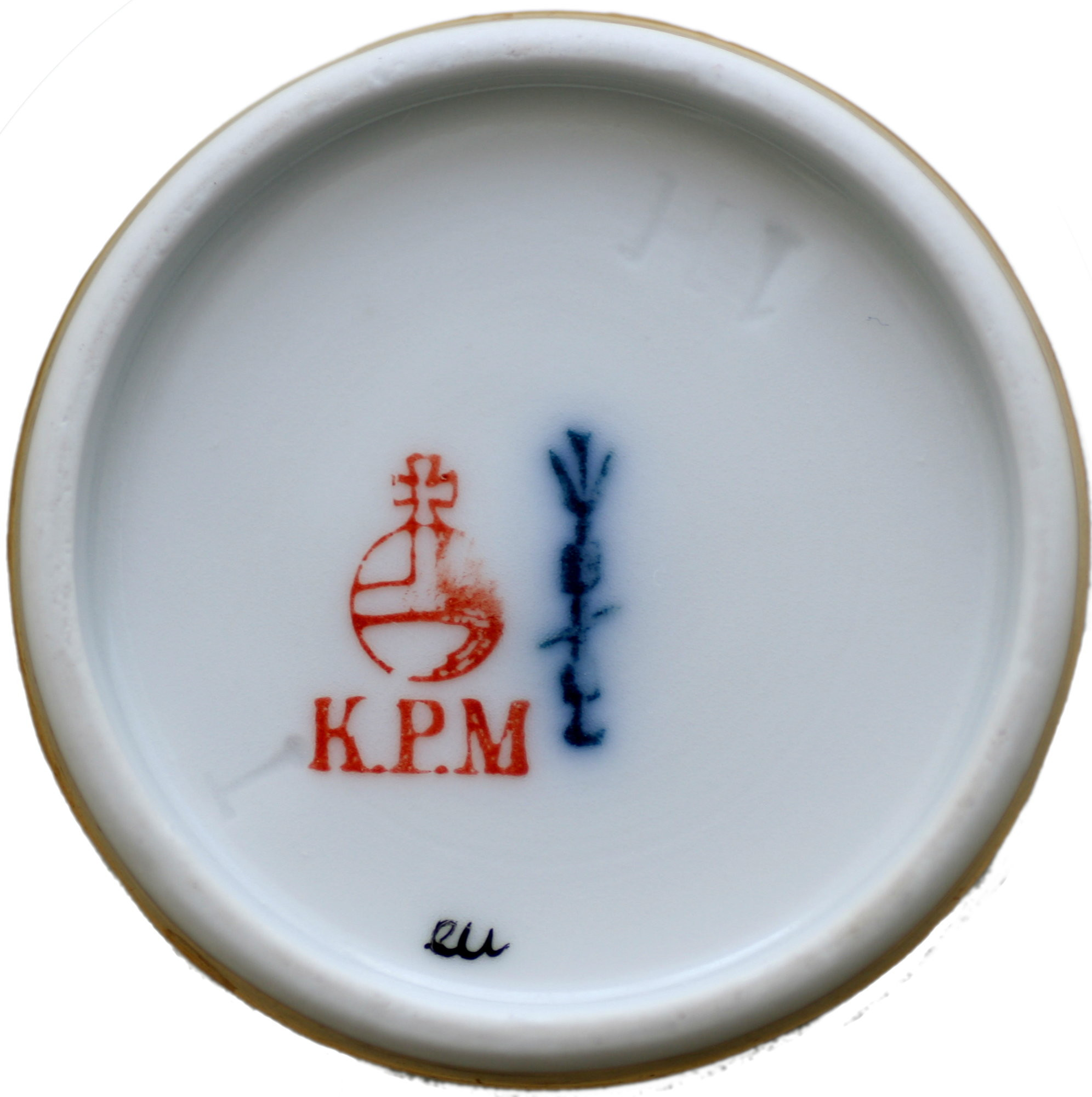
The origins of Berlin porcelain go back to the founding of the Königliche Porzellan-Manufaktur Berlin at 1763, the Prussian porcelain industry took off against a backdrop of growing interest in hard porcelain in Europe. The Kingdom of Prussia sought to compete with the great European manufacturers, and the creation of a royal workshop enabled the development of production that mastered material, firing and decoration. From the outset, the factory distinguished itself by its fine, dense and resistant paste, typical of hard porcelain made using 18th-century European processes.
The first decades saw the development of forms inspired by the late Rococo tradition, with pieces featuring curved lines, to delicate reliefs and meticulously painted floral motifs. The color palette includes blues, pinks, soft greens and hand-applied golds. This decorative language testifies to the aesthetics sought by the Prussian court and a desire to rival the best contemporary productions.
During the 19th century, the Berlin factory modernized its lines while maintaining the technical quality for which it was renowned. The workshops developed table services, vases, figurines and ceremonial pieces combining traditional decoration with discreet neoclassical influences. The use of deep colors such as Berlin blue, combined with gold highlights, became one of the company's visual signatures.
At the same time, the Manufacture is renowned for its carved figurines, often inspired by galant scenes, musicians, dancers or traditional costumes. These pieces bear witness to the precise modeling and finishing skills characteristic of the great European manufactures. Porcelain sculpture occupies an important place in Berlin's production, contributing to its visibility beyond tableware.
In the twentieth century, the company continued to move towards purer shapes and more restrained decoration, without abandoning its historic tradition. In particular, it introduced pieces with a modernized design, playing on the whiteness of the paste and geometric lines. This evolution maintains a balance between respect for heritage and adaptation to contemporary tastes.
Today, the berlin porcelain embodies a heritage combining technical precision, Prussian tradition and continuous adaptation. Its antique pieces are appreciated for the quality of their paste, the finesse of their floral decorations and the richness of their colors. The factory remains a major symbol of hard porcelain in Europe, renowned for its elegance and the continuity of its expertise since the 18th century.