Pair of Vienna porcelain vases
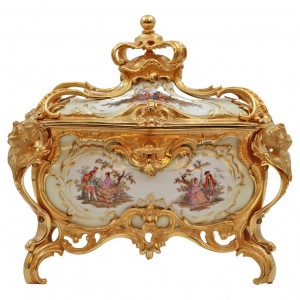
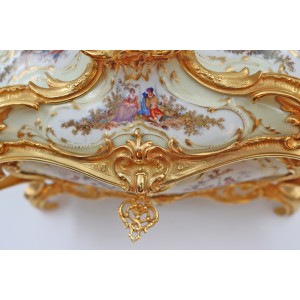
A Pair of Vienna porcelain vases
Orientalist style, of high quality with a golden décor and an elegant portrait of a
From the Napoleon III period.
Height: 40 cm / Width at the handles: 20 cm
A Pair of Vienna porcelain vases
Orientalist style, of high quality with a golden décor and an elegant portrait of a
From the Napoleon III period.
Height: 40 cm / Width at the handles: 20 cm
Vienna porcelain was born in 1718, the first official factory was founded with the support of the Austrian imperial court. After the emergence of Meissen a few years earlier, Vienna became one of the first European centers to master the art of hard porcelain, made from a blend of kaolin, feldspar and quartz. This technical success soon enabled the factory to rival production in Saxony and Bohemia.
The first decades were marked by an aesthetic baroque, this is evident in the rounded shapes, abundant compositions and floral or oriental decorations. The refinement of the paintings, the delicacy of the gilding and the finesse of the white paste all contributed to the reputation of the manufactory. Viennese workshops excelled in the art of miniatures, floral bouquets, figurative scenes and light compositions typical of the central European taste of the 18th century.
From the second half of the 18th century onwards, the factory adopted a new aesthetic rococo then neoclassical, this was in keeping with the evolution of taste at the imperial court. Shapes simplified, lines became clearer and decorations were inspired by Antiquity, with geometric motifs, cameos and garlands. This period also saw the development of porcelain figurines, these include musicians, dancers, gallant figures and stylized animals, all modeled with great precision.
In the 19th century, Viennese porcelain continued to expand, distinguished by a remarkable mastery of painting, particularly scenes inspired by history, mythology and landscapes. Some ceremonial pieces demonstrate exceptional decorative virtuosity, combining gilding, cameos, miniature portraits and narrative compositions.
Despite this refinement, the factory experienced economic difficulties in the 1850s. Faced with growing competition from other European centers and changing markets, production became more irregular. In 1864, the factory officially closed its doors, bringing to an end almost a century and a half of creative activity.
Today, the vienna porcelain is particularly sought-after for the finesse of its decoration, the quality of its paste and the diversity of its repertoire. Her work is an essential testimony to Austrian decorative art of the 18th and 19th centuries, illustrating a set of traditions combining imperial influences, formal elegance and technical excellence.