Umberto Boccioni was born in Reggio Calabriain 1882. He studied graphic arts before moving to Milan, where he discovered the European artistic movements of the turn of the 20th century. His encounter with the Futurist group profoundly altered his approach. The Futurist movement, founded in Italy in the early 1910s, placed the notion of speed, modernity, mechanical energy and the transformation of the modern world at the heart of its thinking. Boccioni adopted these principles and sought to translate them into plastic form.
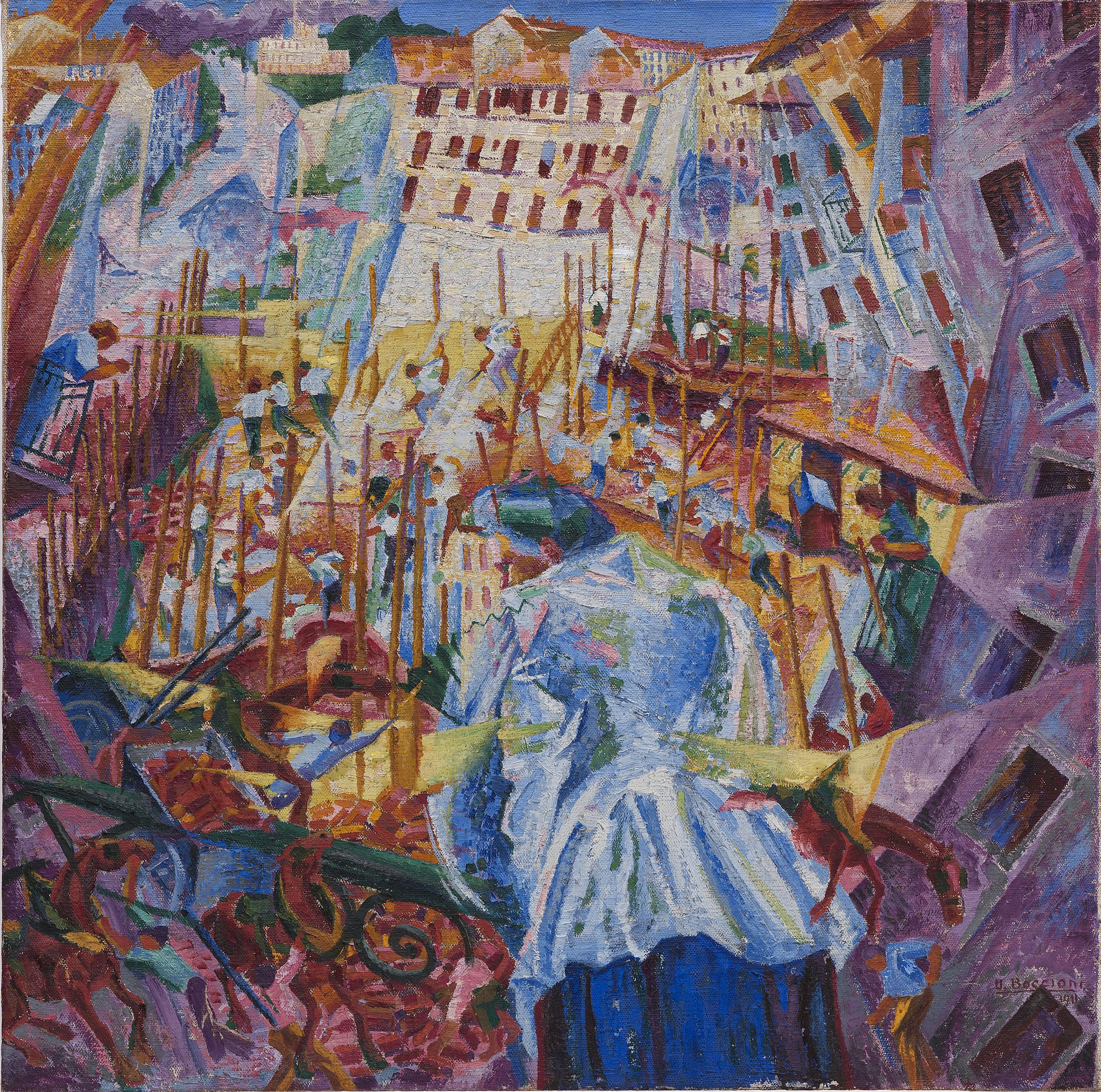
In his painting, he developed a language based on the fragmentation of forms, the multiplication of lines of force and the simultaneous representation of successive states of movement. Human silhouettes, objects and architecture become vibrant structures, traversed by dynamic impulses. His research leads to a new vision of the figure, where the subject seems to extend into the surrounding space.
Sculpture constitutes a decisive stage in his work. Boccioni set out to break with the traditional conception of the closed volume. He sought to integrate space into sculpture, to open up forms, to create tensions and extensions that express the internal energy of movement. This approach results in works in which the figure seems to dissolve and reconstruct itself in a continuous flow. His sculptural research sees the abandonment of stable contours in favor of expanding matter, traversed by impulses that suggest speed.
He played a central role in developing the theoretical principles of artistic Futurism. His texts describe the importance of the surrounding space, the simultaneity of perceptions and the idea that the object cannot be separated from the movement that animates it. These ideas had a lasting influence on the Italian avant-garde.
During the 1910s, Boccioni produced paintings and sculptures that constitute the major works of Futurism. His compositions combine diagonal lines, decomposed volumes and segmented surfaces to express the internal movement of forms. His work as a whole testifies to a desire to go beyond the traditional limits of plastic representation to propose a dynamic vision of the modern world.
Boccioni died in 1916, leaving behind a dense and innovative body of work, albeit concentrated in time. His role in the evolution of Futurism, both theoretically and practically, makes him one of the most influential artists of the early 20th century. His contribution marks an essential moment when the notions of speed, transformation and fusion of forms redefined the language of modern art.