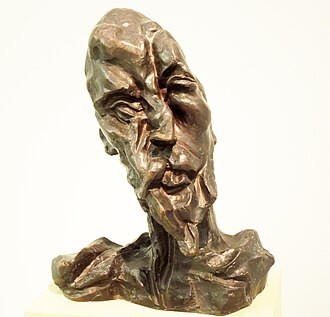
Otto Gutfreund was born in 1889 in Dvůr Králové, Bohemia. He studied sculpture in Prague before continuing his training in Paris, where he discovered the artistic research then shaping the European avant-garde. His arrival in the French capital marked a decisive turning point, as he immersed himself in the artistic milieu and encountered the currents that were to have a lasting influence on his creation.
In the years leading up to the First World War, Gutfreund became one of the pioneers of cubist sculpture. He focused on the relationship between mass, volume and fragmentation, transposing the principles of cubism developed in painting into sculpture. His works from this period are characterized by rigorous construction, surface fragmentation and geometric organization of form. They bear witness to a quest in which the human figure is broken down according to an architectural logic, while retaining an expressive presence.
The war interrupted his career. Taken prisoner, he spent several years in captivity. On his return, in the early 1920s, his language evolved towards a calmer, often figurative sculpture, while remaining structured by great attention to volume. His works combine simplicity of form, clarity of profile and a sense of monumentality.
During the 1920s , Gutfreund also carried out public commissions and created sculptures for urban spaces, enabling him to develop a body of work combining legibility, balance and mastery of composition. This period confirms his ability to transpose his formal research into more accessible works, without abandoning the rigor acquired within the cubist avant-garde.
His work reflects a career marked by the tension between experimentation and a return to classicism. The first, cubist phase explores the boundaries between sculpture and architectural construction. The second, more figurative phase reveals an artist seeking to reconcile modernity and humanism. This duality gives his work a particular depth in the context of early 20th-century European sculpture.
Otto Gutfreund died in Prague in 1927. He left behind a body of work that occupies an essential place in the history of modern sculpture. His cubist research is one of the most significant contributions to the transformation of three-dimensional language in the first half of the twentieth century.