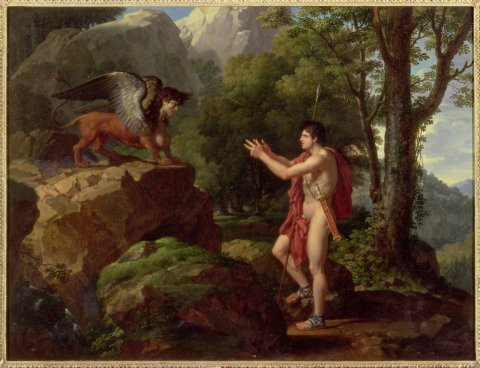
François Xavier Fabre: a great master of French and European neoclassicism
Born in Montpellier in 1766, François Xavier Fabre trained in Paris at Jacques Louis David, a central figure in neoclassicism. Thanks to this prestigious training, he acquired a keen sense of drawing, academic rigor and structured compositions.
His talent was revealed at an early age when he won the Prix de Rome in 1787 with a remarkable historical work.
An artist shaped by the neoclassical tradition
Like the great painters of his movement, Fabre developed an aesthetic based on :
the primacy of drawing,
clarity of line,
balanced composition,
antique inspiration,
expressive sobriety.
His paintings express the nobility, restraint and intellectual mastery characteristic of late 18th-century French neoclassicism.
Moving to Florence: an international career
After the French Revolution, Fabre left Paris and settled in Florence, he became one of the most sought-after portraitists of Italian and European high society.
In this city of art and history, he developed his taste for the Renaissance, whose plastic purity and psychological depth he admired.
The portraits Fabre created during this period are among the most refined of his work. He deploys :
a keen sense of observation,
a great elegance of attitude,
subtle rendering of textures and accessories,
a rare ability to capture a model's personality.
A sought-after and appreciated portraitist
Fabre painted aristocrats, intellectuals, musicians, diplomats and European travelers passing through Italy.
His portraits combine anatomical precision, sober staging and soft lighting, giving his models a presence that is both real and idealized.
This mastery places him among the leading neoclassical portraitists active in Europe at the turn of the 19th century.
A work of history and narrative
In addition to portraiture, Fabre excelled in history painting, the Académie's leading discipline.
He depicts scenes from Antiquity, mythology or great literary episodes.
His structured, elegant compositions reflect his attachment to the moral values, heroism and intellectual ideals of Neoclassicism.
This dual mastery of portraiture and history makes Fabre a complete artist.
A patron, collector and cultural player
François Xavier Fabre also played an important role in the cultural life of Montpellier and Florence.
A passionate collector, he bequeathed a large part of his works and collection to his hometown, helping to found the Fabre Museum, one of France's most prestigious regional museums.
This gesture testifies to his commitment to the dissemination of the arts and his desire to pass on his legacy.
A painter now rediscovered and celebrated
Fabre's work has been enjoying renewed interest for several decades.
Museums, historians and collectors alike emphasize the exceptional quality of his drawings, the elegance of his style and the importance of his role in the transition between the classical 18th century and the early 19th century.
To own a work by François Xavier Fabre is to welcome a piece of rare finesse from one of Europe's greatest neoclassical portrait painters.