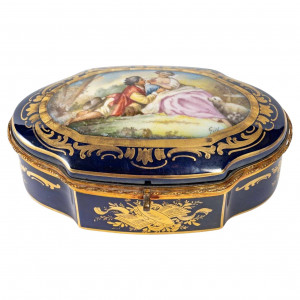
The Manufacture de Sèvres has its origins in the workshops at Vincennes, founded in the mid-18ᵉ century, before moving to Sèvres in 1756 with the support of the monarchy. This new location, with its more extensive infrastructure, enabled the manufactory to become a major centre of porcelain production, combining technical innovation with excellence in craftsmanship. From the outset, Sèvres helped to develop a decorative language that was unique to France, at a time when porcelain played an essential role in the European decorative arts.
The company first made a name for itself in soft porcelain, a material prized for its softness, brilliance and the finesse of its decorations. The transition to hard porcelain, which began at the end of the XVIIIᵉ century, marked a new stage in the history of Sèvres. This material, which was stronger and more stable in the kiln, made it possible to create ambitious shapes and complex decorations. The workshops mastered a whole range of skills involving modellers, turners, moulders, painters, gilders and chemists, all of whom were essential to the production of the pieces.
Throughout the XIXᵉ century, Sèvres continued its development by developing new colours, new backgrounds and demanding gilding techniques. Painted decorations, figurative ornaments and motifs inspired by Antiquity, nature or the graphic arts bear witness to a constantly evolving visual language. The manufactory also plays a central role in the creation of official services, monumental vases and pieces for international exhibitions, consolidating its status as a state institution dedicated to excellence in the arts of fire.
In the 20th century, Sèvres became more open to contemporary creation. By inviting artists, designers, architects and sculptors, forms and uses were renewed without breaking with the technical requirements that had made the manufactory's reputation. The workshops develop new glazes, refine colours and experiment with sculptural forms, giving rise to works in which tradition and creation are in close dialogue.
The manufactory also retains a museum role, thanks to a heritage made up of models, moulds, archives and historical pieces that enable us to understand the evolution of production since the XVIIIᵉ century. This continuity contributes to the reputation of Sèvres as an institution where the durability of the manual gesture is combined with a constant exploration of the possibilities of porcelain.
Today, the Manufacture de Sèvres remains a symbol of French expertise. Its workshops perpetuate a tradition of firing, decorating and modelling whose precision is internationally recognised. The hard porcelain creations, sculptural pieces and decorative objects produced at Sèvres bear witness to a mastery of craftsmanship and artistic research that has lasted for almost three centuries.