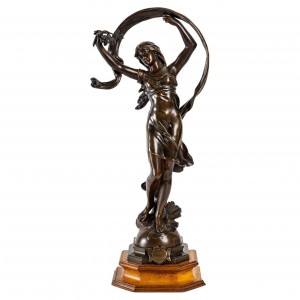
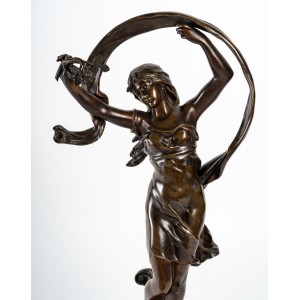
List of products by brand Mathurin Moreau
Mathurin Moreau (born 1822 in Dijon - died 1912 in Paris) was a French sculptor of the XIXᵉ century, representative of the academic style. Born into a dynasty of artists, he produced most of his work in monumental and decorative statuary, combining marble, bronze or cast iron. He was also active in urban and funerary decoration, and held public office in Paris.
Mathurin Moreau was born on 18 November 1822 in Dijon, in a family of goldsmiths and sculptors. His father introduced him to the arts of modelling and sculpture from an early age, and in 1841, l'Paris School of Fine Arts, where he studied with masters such as Jules Ramey and Auguste Dumont. The following year, in 1842, he was awarded the Second Grand Prix de Rome with his work" Diodeme taking the Palladium", rewarding his budding talent.
He made his public debut at Salon of 1848, at the end of the 19th century, he presented "L'Élégie", a work that brought him considerable attention. Throughout his long career, he distinguished himself by the variety of his work, ranging from funerary sculpture to urban décor, allegorical groups, mythological figures, commemorative monuments and fountains. His work often appeared in public spaces or in civil architecture, giving him a high and lasting profile.
Between 1849 and 1879, mathurin Moreau works with the Fonderie du Val d'Osne, he became one of its directors, helping to distribute his cast iron and bronze models on a large scale. This partnership made his work accessible to a wide audience and led to the installation of many of his sculptures in public buildings and villas in France and abroad.
At the Universal Exhibition in 1855, he was awarded a second-class medal; he was awarded a first-class medal in 1878, then a medal of honour at the Salon in 1897 awards which crowned a rich and varied career. As well as artistic recognition, he also had a notable civil career: elected mayor of 19ᵉ arrondissement of Paris from 1879, he combined municipal responsibilities with artistic creation until his death in 1912.
His work, faithful to the canons of the academic style, favours balance, fine modelling, refinement and an allegorical or monumental character. Some of his most remarkable works in marble, bronze or fonts occupy public spaces and museums. Whether in the form of statues, busts, fountains or monuments, Mathurin Moreau combined a career as an artist with a deep understanding of public commissions and monumental statuary.
In this way, Mathurin Moreau remains a significant figure in French academic sculpture of the XIXᵉ century, embodying tradition, technique, the adaptation of sculptural forms to urban modernity and the spread of art throughout society. His dense and diverse oeuvre is a lasting testimony to the official and civic art of his time.