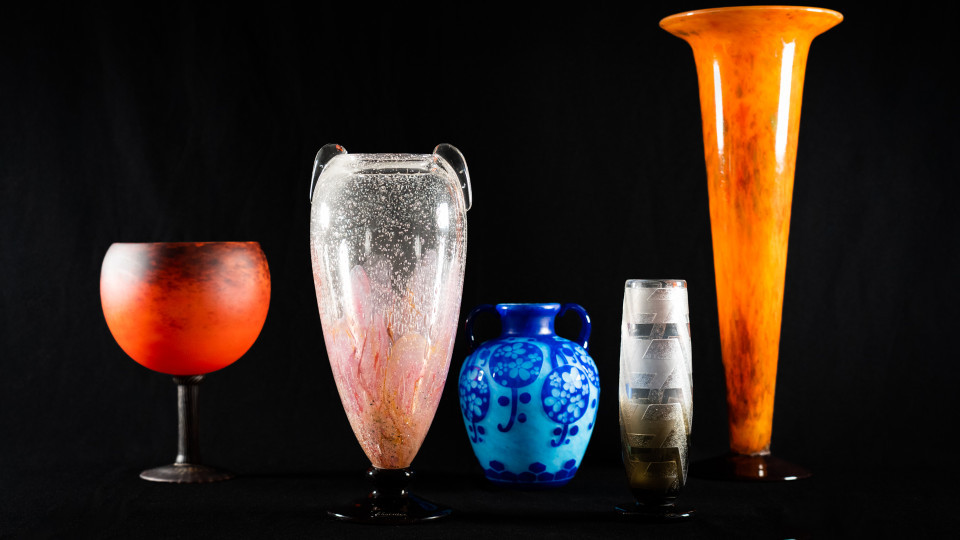
Charles Schneider: colour and light at the heart of Art Deco
Born in 1881 in Château Thierry, Charles Schneider trained in the art of glass at a very early age, first at the Ecole de Nancy and then in contact with emblematic master glassmakers. His career led him to work alongside Émile Gallé, whose sense of decoration, technical skills and creative freedom he retained. This experience laid the foundations for Schneider's artistic personality, which was already focused on innovation and expressiveness.
The founding of Schneider
In 1913, Charles and his brother Ernest set up their own glassworks in Épinay sur Seine. The company quickly attracted attention for the strength of its aesthetic signature. After the First World War, production boomed thanks to an original style that broke with academic traditions. This new direction made Schneider one of the most dazzling representatives of Art Deco glassmaking.
A vibrant, free and colourful aesthetic
Charles Schneider's work is distinguished by its bold use of colour. His vases and lamps feature flamboyant gradations, abstract motifs, inclusions of matter and luminous contrasts of great intensity. Sculpted glass paste, superimposed enamels, layers of glass and applications of coloured powders give his creations exceptional visual depth.
The shapes, often simple and architectural, serve as a showcase for these chromatic combinations. They express a modernity that is perfectly in tune with the Art Deco aesthetic.
Schneider is constantly experimenting. Among his most characteristic processes:
molten coloured inlays,
vitrified powders to create cloudy textures,
superimposed layers accentuated by light,
satin or polished finishes,
acid-etched decorations depicting stylised motifs.
These technical innovations give his works an instantly recognisable identity.
The Art Deco period and international success
In the 1920s, Schneider was at the height of its success. Under the brand names Schneider, Le Verre Français and E. et Cie, production expanded, attracting lovers of decorative art the world over. The fluid lines, stylised geometric designs and masterful colour combinations made Schneider glass an essential benchmark for the period.
Charles Schneider's creations are shown at international exhibitions and adopted by collectors who are seduced by their modernity, strength and elegance.
A lasting legacy in French glass
After the economic crisis of the 1930s and the closure of the glassworks in 1938, Schneider's work continued to be recognised for its creativity and its importance in the history of the decorative arts. Today, museums, collectors and galleries regard his pieces as major witnesses to the aesthetic revival of French glass in the 20th century.
To own a work by Charles Schneider is to embrace a fragment of Art Deco at its most luminous: an exceptional mastery of colour, a rare technical inventiveness and a profoundly modern sensibility.