Henri Peinte: an academic sculptor steeped in Antiquity and realism.
Born in Cambrai in 1845, Henri Peinte grew up in an environment sensitive to the arts, his father being an architect. This early immersion in drawing and construction led him naturally to sculpture. He first trained at the drawing school in his home town, before entering the École des Fine Arts paris on a scholarship. There he studied with several masters of French academic sculpture, developing a solid technique based on observation, anatomy and composition.
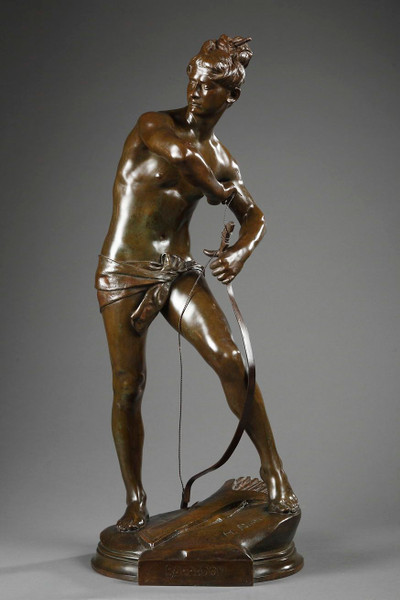
From 1877, Peinte exhibited regularly at the Salon. Her most famous work, Sarpedon bending his bow, reveals his pronounced taste for ancient mythology. The posture of the Lycian hero, the anatomical precision, the taut modelling and the restrained strength make this sculpture a perfect example of his style. The piece was produced in bronze by the foundry Siot Decauville, and its distribution contributed to its renown. Peinte won a medal on her first entry, demonstrating a talent recognised by critics and the public alike.
Henri Peinte's repertoire revolves around three main themes: mythology, , allegory, and the heroic figure. His compositions include Orpheus Sleeping Cerberus, which illustrates his attraction to ancient stories, dramatic scenes and suspended gestures. He also created allegories such as History and symbolic female figures, borrowing as much from the realism of his time as from the idealised codes of neoclassical sculpture.
Peinte's style is based on a subtle combination of tradition and expressiveness. Volumes are clean and well-structured, muscles precisely rendered but without excessive emphasis. The poses, often inspired by ancient statuary, are balanced, elegant and full of inner tension. He masters both marble and bronze, working the patinas with care and seeking a finish that reveals the softness of the surfaces or the vigour of the silhouettes.
His success at the Salon and at the 1889 Universal Exhibition earned him the title of Chevalier de la Légion d'Honneur. Despite this official recognition, his career remained relatively discreet, which explains the rarity of his works today. This rarity makes his bronzes all the more attractive to collectors, as they are often held in private collections or are part of the heritage of French academic sculpture.
Henri Peinte's legacy is part of the great tradition of French sculptors of the late XIXᵉ century. His works bear witness to a perfect mastery of technique, a strong attachment to antique models, and a keen sense of narrative staging. To own a bronze by Henri Peinte is to acquire a work at the crossroads of classicism and academic romanticism, imbued with strength, elegance and history.