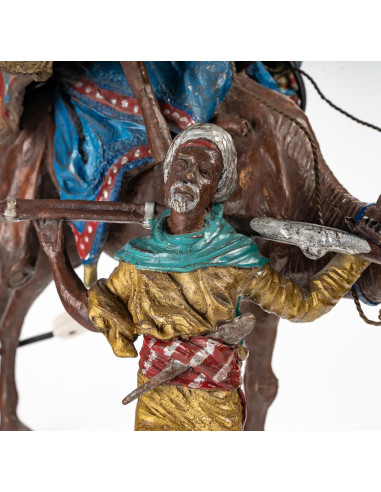
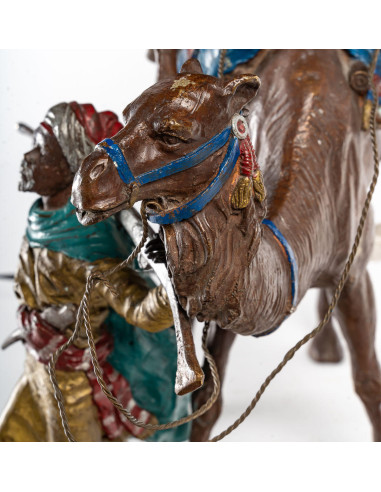
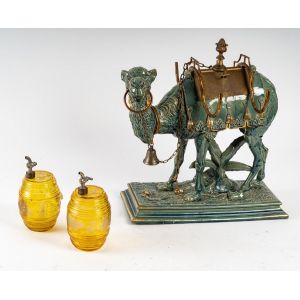
Important Vienna Bronze, Nightlight by Franz Bergmann, Orientalist
Franz Bergmann was born in Vienna in1838, at a time when decorative sculpture and the production of bronzes were developing. He was part of the Viennese tradition of producing small-format bronzes for a bourgeois clientele of collectors who were attracted by refined, narrative decorative objects. His work developed in an environment where the quality of the cast and the richness of the finish played a central role.
Bergmann is particularly renowned for his polychrome bronzes, often signed under variants of his name. These sculptures are characterised by the careful application of colour, which accentuates the narrative and decorative character of the scenes depicted. The subjects are varied and include orientalist scenes, exotic figures, animals and genre compositions, reflecting the European imagination of the late nineteenth century.
Bergmann's sculptures are generally small to medium-sized. They display great descriptive precision, both in the modelling and in the treatment of detail. Costumes, props and scenery are meticulously rendered, giving the works a markedly illustrative dimension. This attention to detail contributes to the decorative appeal of his bronzes.
Bergmann's work is fully in keeping with the aesthetics of his time, when orientalism and exoticism played an important role in the decorative arts. His works reflect a taste for visual narrative and animated scenes, designed to be observed at close quarters. Polychromy reinforces this proximity, giving the sculptures a living, immediately perceptible presence.
Franz Bergmann also played the role of publisher, organising the production and distribution of his bronzes. This publishing role enabled his works to be distributed relatively widely, while maintaining a high level of manufacturing quality. The bronzes produced by his workshop bear witness to a mastery of technical skills and an identifiable stylistic coherence.
Franz Bergmann died in 1894. His work remains representative of Viennese decorative sculpture at the end of the 19th century. The polychrome bronzes associated with his name are appreciated today for their finesse of execution, their narrative richness and their place in the history of European decorative arts.