Wilhelm Lehmbruck was born in Duisburgin 1881. Trained at German art schools at the turn of the twentieth century, he developed an early sensitivity to the expressive nature of the human body. His training led him to take an interest in the representation of the nude, stretched proportions and the ability of sculpture to convey an inner state. His early works reveal a naturalist approach, which was quickly overtaken by a desire to simplify and intensify forms.
His stay in Paris in the early 1910s marked a decisive stage. There he discovered the modern trends in European sculpture and developed a personal language based on elongated figures, stylised limbs and a melancholy or meditative attitude. This aesthetic, close toExpressionism, is embodied in works in which the verticality, the tension of the lines and the gravity of the gesture convey a deep inner dimension.
Lehmbruck favours the human figure as his central subject. His sculptures, often made in plaster, stone or bronze, are characterised by a particular relationship between mass and lightness. The bodies seem both anchored in the ground and pulled upwards by an invisible force. This duality lends his works an introspective atmosphere. The faces, with their simplified features, accentuate this search for inner calm and spirituality.
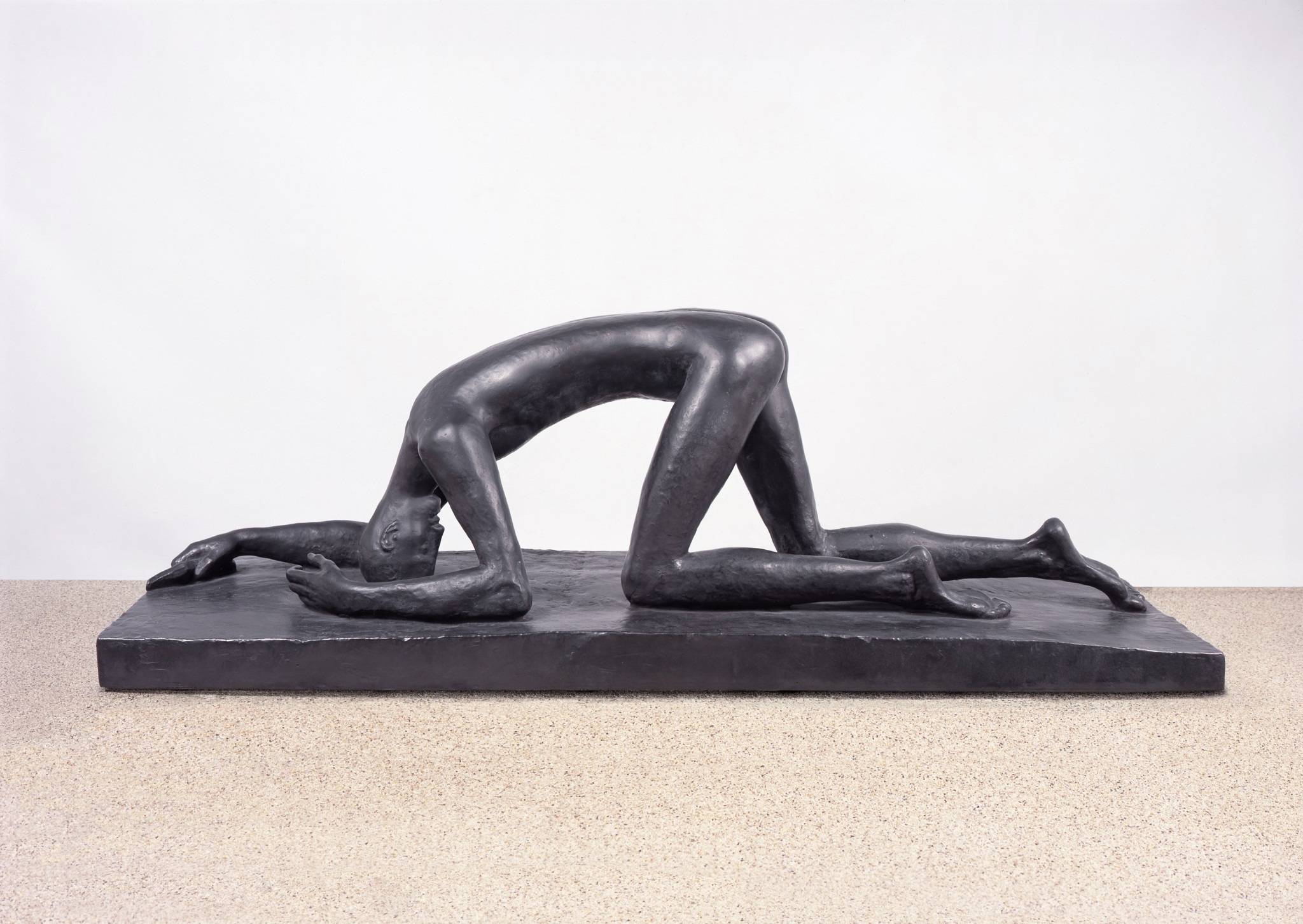
During the First World War, the experience of collective suffering influenced his work. He produced figures whose posture conveyed a strong emotional intensity. For him, sculpture became a means of expressing human fragility, solitude and the search for meaning in a troubled historical context. This dimension gives his work an important symbolic significance in the artistic landscape of his time.
His compositions strike a subtle balance between technical rigour and spiritual elevation. The long forms, delicate twists and pure volumes create an atmosphere of silence, almost of contemplation. The mature works reinforce this expressive line. Lehmbruck developed a sculpture in which space, the body and verticality interact to express an inner state rather than anatomical realism.
Wilhelm Lehmbruck died in 1919. Despite a brief career, he left behind a body of work that occupies an essential place in expressionist sculpture. His slender, timeless and profoundly human figures bear witness to a constant search for spirituality through form, and to a major contribution to European plastic modernity.