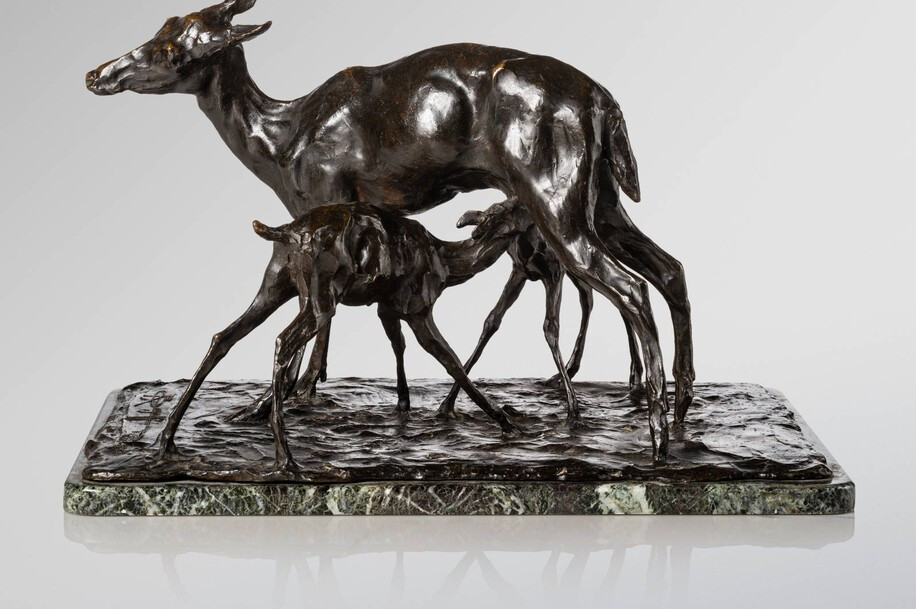
Rembrandt Bugatti was born in 1884 in Milan into a family of artists. From an early age, he turned to sculpture, developing a particular affinity for the representation of animals. His apprenticeship took place in a creative environment that enabled him to experiment with clay modelling and then bronze casting. His early work reveals a sensitivity to animal life, which he approaches with constant attention to movement and anatomy.
In the 1900s, he moved to Paris, where he frequented zoos and foundry workshops. Daily observation of animals became the basis of his creative process. Lionesses, panthers, okapis, elephants, horses and gazelles formed a repertoire that he studied directly from life. His sculptures bear witness to an attentive eye and an ability to capture the energy, tension or gentleness of animal attitudes.
Bugatti adopts a lively, nervous modelling, the technique is characterised by small touches of material, often left visible after casting. This technique creates vibrant surfaces that seem to come alive from within. He favours natural postures, sometimes motionless, sometimes tense, seeking to convey the animal's real presence rather than an idealised image. This immediate relationship with the subject sets his work apart from the animal sculpture of the early twentieth century.
From 1907, bugatti regularly works on theAntwerp Zoo, where he produced a large number of models. The diversity of species he observed there enriched his formal vocabulary. This period saw the creation of some of his best-known sculptures, marked by expressive force and great fidelity to animal attitudes. Bronze, a material he mastered perfectly, enabled him to translate these variations with precision.
His sculptures were well received at exhibitions, where his style was recognised for its authenticity and rigour. Despite this high profile, Bugatti's life was marked by financial and emotional difficulties, particularly during the First World War. His career came to an abrupt halt in 1916, the result is a concentrated work of remarkable intensity.
Today, Rembrandt Bugatti is regarded as one of the leading figures in modern animal sculpture. His work, based on direct observation, the strength of his modelling and the truth of his gestures, occupies an essential place in the history of twentieth-century sculpture. His bronzes are sought after for the quality of their execution and for the rare expressiveness they confer on animal subjects.