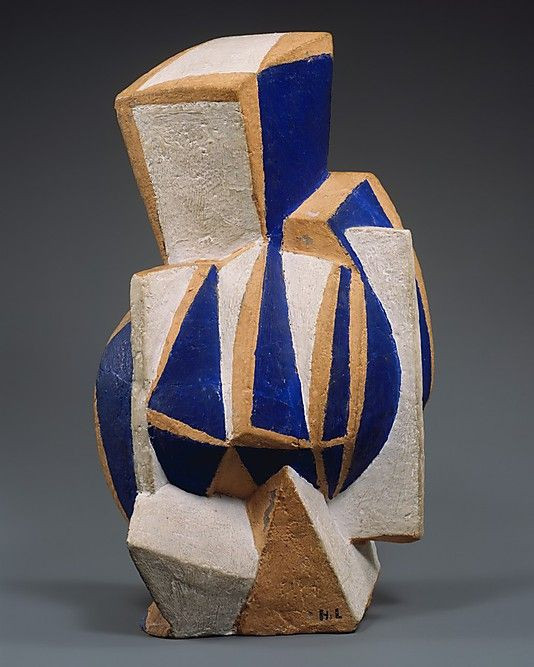
Henri Laurens: a central figure in modern sculpture. Born in Paris in 1885, Laurens started out as a decorative craftsman and wood sculptor before being introduced to the Parisian avant-garde. His encounter with Cubism between 1911 and 1915 radically transformed his practice. Very early on, he adopted the principles of the movement, exploring the fragmentation of volumes, the balance between plane and depth, the simplification of forms and a new conception of space. Laurens was not content to imitate cubism in painting: he created a genuine sculptural translation of it , bringing sculpture into the modern age.
In his first works, he worked with cardboard, wood, plaster and stone, constructing assemblages that resembled miniature architectures. These experiments gave rise to angular, structured and bold volumes. However, after the First World War, his style evolved towards curvier, more lyrical forms, where geometric rigour gave way to a new sensuality. Laurens became one of the inventors of a softened Cubism, embodied by his emblematic female figures, his bathers, his muses and his massive, rounded silhouettes.
His sculptures combine power and gentleness. The volumes seem inflated with air, as if modelled from within, and yet each figure remains firmly anchored in space. This tension between monumentality and lightness is one of Laurens's strong signatures. Whether his works are carved in stone, cast in bronze or made in plaster, they retain a harmonious balance and a visual musicality that give them a profoundly modern character.
Laurens is also an engraver and illustrator, collaborating with numerous poets and writers. His prints dialogue with his sculptural work: the same curves, the same stylisation, the same relationship to femininity and inner movement. He also created theatre sets, models and decorative compositions, all of which testify to the versatility of his talent.
From the 1930s onwards, he gained international recognition. His works found their way into the most prestigious museums, and he took part in major exhibitions in Europe and the United States. After the Second World War, his style reached full maturity: monumental female figures, bathers sculpted like living architectures, powerful compositions combining balance and fullness. His sculpture became a universal language based on curves, mass and light.
Henri Laurens died in 1954, leaving behind a body of work that is now considered one of the most important of European modernism. Alongside Picasso, Arp and Brancusi, he redefined the place of sculpture in the 20th century by creating a profoundly original formal vocabulary. To own a work inspired by Laurens is to welcome a piece where modernity, poetry and the power of form come together in rare harmony.